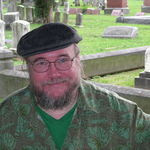
The tattooed man struck her as ominous
When she first saw him naked. But his face,
Wet from the pool, seemed open as his hands.
She scanned him for that quality that glows
From inside, and believed it there. His blue
Eyes didn’t hurt. She watched close for what moves.
Beauty seems a firm first basis, and moves
us in lieu of facts. Some call this ominous.
Nonetheless, her mood would shift the lights to blue
If she should pass a day without his face
Turned to hers. Anything that hums and glows
Needs tending. Soon this duty filled his hands.
He’d always had some task to suit his hands,
But he was used to wood, not clay that moves.
He’d shape her in ways that, sometimes, glow
And sometimes throw a shadow, ominous.
He’d read few books, and could not read her face.
He’d babble with no clue till his turned blue.
Her righteousness bewildered him. Soon blue
Became the shade of all his days. His hands
Strayed to more pliant subjects. Soon his face
Spoke fluently to her, and she made moves
That anyone could read as ominous.
Still he was startled, flushed with rage that glows.
Some men can’t see what, to some others, glows,
She found a substitute to light her blue
Flame, who bore a resemblance ominous
That she did not see. She fit in his hands.
Meanwhile, her “old man” wondered if his moves
Had failed him. With age, pain showed in his face.
Things occurred to him – hard for a man to face.
His inked skin was a warning sign that glows.
At his age, he could not count on old moves
That long ago could turn her music blue.
He had a problem in his empty hands.
The situation seemed quite ominous.
Ominous indeed. We see just the face
We first find in our hands. Eyes open, glow
Blue – we believe their light. And then time moves.
-- © 2009 by Jack Veasey
All rights reserved. This work may not be duplicated or reproduced in any way without the author's written permission.
The above poem is a sestina. It's probably the hardest poetry form, and I've made several failed attempts to write one over my thirty-some years as a poet. This is the first one that's worked.
The form uses six words to end its lines, which in this case are "ominous," "face," "hands," "glows," blue," and "moves." The first six stanzas each have six lines, and the end words fall into a prescribed pattern -- for instance, the last end word in each stanza becomes the first end word in the next. All six end words then appear in their original order in the final three-line stanza. Then you down six shots of Jim Beam, scream into a pillow for six minutes, and hibernate for six months. (Just kidding!)
When it works, you have a hypnotic, beautiful poem. But you have to be REALLY careful to pick six words that bear that much repeating.
Sunday, March 7, 2010


Saturday, March 6, 2010
HAPPY HOUR

Photo by Hovev
He shows up beside you
At the bar.
You’ve stopped in
To recuperate from work
Before the shaky subway sojourn
Home. You imagine
He has, too.
You’ve never liked him
All that much. Easier
To keep him friendly, though.
You tell him you’re doing OK
And let him ramble.
He goes on about Elaine.
Her cubicle
Is not that far from yours
Or his. He tells you
She’s a lesbian.
He heard her
Talking to her girlfriend
On the phone, then
Glimpsed them
Meeting on the street.
You barely know the girl,
But like her more
Than him – seems like
A reasonable person.
You nod
And grunt, expressing
No opinion.
He reads this
As a show of interest,
Keeps on talking,
Gathering excitement,
Wonders
If you’ve pictured girls together.
It’s clear to you
That he has.
You say nothing, stare
Into the depths of your beer.
He says he bets
That a real man
Could change Elaine.
She wouldn’t want a woman
If she tried
A guy like you,
For instance.
You check his eyes
And see
He’s also pictured
That. And he wants
To plant that picture
In your head, hopes
You’ll tell him
If anything happens.
You down
Your nearly full beer
In one gulp,
Slap the tip
On the bar, check
Your watch. You lose track
Of the rest of what
He’s saying. Your partner
Is waiting at home. This guy
Has no clue who you are.
Outside,
You walk briskly alone.
The smog-infested air seems
Fresh and sweet.
Even the screeching subway
Sounds like music.
-- © 2010 by Jack Veasey
All rights reserved. This work may not be reproduced or duplicated in any way without the author's written permission.
Thursday, March 4, 2010
PITCHMAN

(photo by Sharese Ann Frederick)
In Memory of Billy Mays, 1958-2009
Burly and bearded, shirt sleeves
Half rolled up, he holds his product
And barks at the camera
In a voice pitched higher than you’d think.
His tenor’s not the lone surprise.
It seems he’s always selling something different:
Super strong adhesive,
Putty that seals leaks,
A wash that smells like oranges
But cuts through years of crud
When rubbed on any surface.
He looks like a bear
And sounds like a songbird, albeit
A loud one; his smile
Is so white, it could blind you –
Anyway, you just can’t help
But trust him. You thank God
He doesn’t sell religion.
You hear there’s a fan club
Of gay men who wish
He would bed them, but he’s faithful
To his lucky wife.
You see him on the tube
Practically every day
For decades.
When you hear
That he’s died suddenly,
You feel a pang.
You wish you had opened
Your wallet,
And not just your heart.
-- © 2010 by Jack Veasey
All rights reserved. This work may not be reproduced or duplicated in any way without the author's written permission.
GUTTER SAILORS
Streets run like water
Spilled on the world,
Streaming
In bright sunlight, hissing
On the way.
Street kids play
With paper boats
That float in gutters,
Catching them
Before they reach
The sewer, unafraid
Of cars
Or germs.
But unlocking
The fire hydrant
Is a crime. Hide
The magic wrench,
or it might get confiscated
By the cops!
Sadly, it isn’t safe
To play at the real river,
Only half a block away.
The cops find
Bodies
Floating there.
-- © 2010 by Jack Veasey
All rights reserved. This work may not be reproduced or duplicated in any way without the author's written permission.
Yeah, I know. "Morbid" ending, right? I refuse the label "morbid" because it implies it's inappropriate to write (or even think) about certain subjects. Growing up in the city, we were all aware that playing in the streets had an element of danger. And the river -- the Delaware, which flowed right behind my house -- was even more unsafe. If we had forgotten this, we might not be here today.
But by the way, there was originally a "Mary Sunshine" version of the poem, with this additional stanza at the end:
All the more reason
For defiance,
For just grabbing
Any shred of joy
You can.
Fellow poets advised me to edit it out, which felt right to me. I guess we're all "morbid!"
Spilled on the world,
Streaming
In bright sunlight, hissing
On the way.
Street kids play
With paper boats
That float in gutters,
Catching them
Before they reach
The sewer, unafraid
Of cars
Or germs.
But unlocking
The fire hydrant
Is a crime. Hide
The magic wrench,
or it might get confiscated
By the cops!
Sadly, it isn’t safe
To play at the real river,
Only half a block away.
The cops find
Bodies
Floating there.
-- © 2010 by Jack Veasey
All rights reserved. This work may not be reproduced or duplicated in any way without the author's written permission.
Yeah, I know. "Morbid" ending, right? I refuse the label "morbid" because it implies it's inappropriate to write (or even think) about certain subjects. Growing up in the city, we were all aware that playing in the streets had an element of danger. And the river -- the Delaware, which flowed right behind my house -- was even more unsafe. If we had forgotten this, we might not be here today.
But by the way, there was originally a "Mary Sunshine" version of the poem, with this additional stanza at the end:
All the more reason
For defiance,
For just grabbing
Any shred of joy
You can.
Fellow poets advised me to edit it out, which felt right to me. I guess we're all "morbid!"
Wednesday, March 3, 2010
VISITING AMBER

(photo (c) Ralf Schmode)
I want to revisit the house
Where the white wolf lives.
I only went there once.
She came right up to me
And sniffed my hand.
I called her “Sweetheart,”
Though her name was Amber.
She looked right
Into my eyes,
Followed me
All over the house.
Her owner – if you can call her that –
Said, “She must like you.”
I also met a caged squirrel
With a broken back
Who’d come there to retire.
(The lady of the house
Worked for the Game Commission).
Amber seemed to have no interest
In the squirrel,
But, when I sat on the sofa, tried
To climb onto my lap.
“She’s not allowed up on the furniture,”
The lady said -- like anyone
Could stop her.
Amber kept her back legs
On a hassock, lay her head
Against my chest. I’d go home
covered in white fur.
“Weren’t you afraid?”
A friend would ask me later.
“No,” I said. “She was
So beautiful.” And she was smaller
Than I thought she’d be,
And seemed so dignified
And strangely delicate.
My only disappointment in the visit?
She found no reason to howl.
-- © 2010 by Jack Veasey
All rights reserved. This work may not be reproduced or duplicated in any manner without the author's written permission.
SISTER EMANUEL’S CONVENIENCE STORE TRIP

(photo by Doris Ullman, 1930)
A nun entered the convenience store. The clerk on duty quickly hid his hard core porno magazine.
She glimpsed it before it went under the counter. Inwardly, she cursed her curiosity. Trying to weed out one’s interest in sex, she thought, is like trying to find zebras under a microscope. Once again, the colors of her habit made her think of zebras, not the penguins of cliché. She pictured a stampede of tiny zebras on a slippery glass strip, a doctor finding zebras in a teardrop.
She bought band-aids, Ben Gay, and Gatorade.
Her mind filled with things miscellaneous: pyramids and ceiling fans, tattoos and powdered wigs, fists and French kisses. The porn glimpse had triggered her imagination.
As she passed through the front door she saw the cover of a tabloid, with the photo of a frat boy in a wedding dress beneath the words, PLEDGE STUNTS. She silently thanked God they hadn’t made him wear a habit. Then she smiled, despite herself, at that last image.
In her mind, to chastise her, a mushroom cloud appeared behind the crosses three on Calvary.
Some fears are bigger than God.
-- © 2010 by Jack Veasey
All rights reserved. This work may not be reproduced or duplicated in any manner without the author's written permission.
Tuesday, March 2, 2010
GRIN AND BEAR

(Flickr photo by HBarrison)
We argued in your truck
Out on the road.
I can’t remember
The subject, only
A welcome interruption:
As you flashed
Your hot blue eyes at me,
A black bear came
Scampering out of the woods
Into our path, oblivious
To us as you, the driver,
Were to him. I lay my hand
Gently on your thigh. “Look,”
I said, in a quieter voice
Than either of us had been using.
You did. You saw.
As if feeling
Your eyes on him,
The bear looked up at us.
Startled, he jumped straight up
Into midair, like some old
Cartoon character – all four paws
Left the ground at the same time.
He turned and scampered
Back into the woods –
And that’s
The only verb for it;
Delicately, like a romping lamb.
We both
Forgot our argument. We’d both known
That this area had bears, but neither of us
Had seen one before.
We shared a grin, and drove on
In delighted silence.
I left my hand
Where it was.
-- © 2009 by Jack Veasey
All rights reserved. This work may not be reproduced or duplicated in any manner without the author's written permission.
Subscribe to:
Posts (Atom)